
Dead Fuel Moisture, Built From Scratch: Why Leaves Dry in an Hour and Logs Take Months
I built a tiny dead fuel moisture simulator to see why leaf litter dries in hours while logs take months. Here is what 1-, 10-, 100- and 1000-hour fuels mean, and the humidity levels where a burn goes from smoldering to spotting.
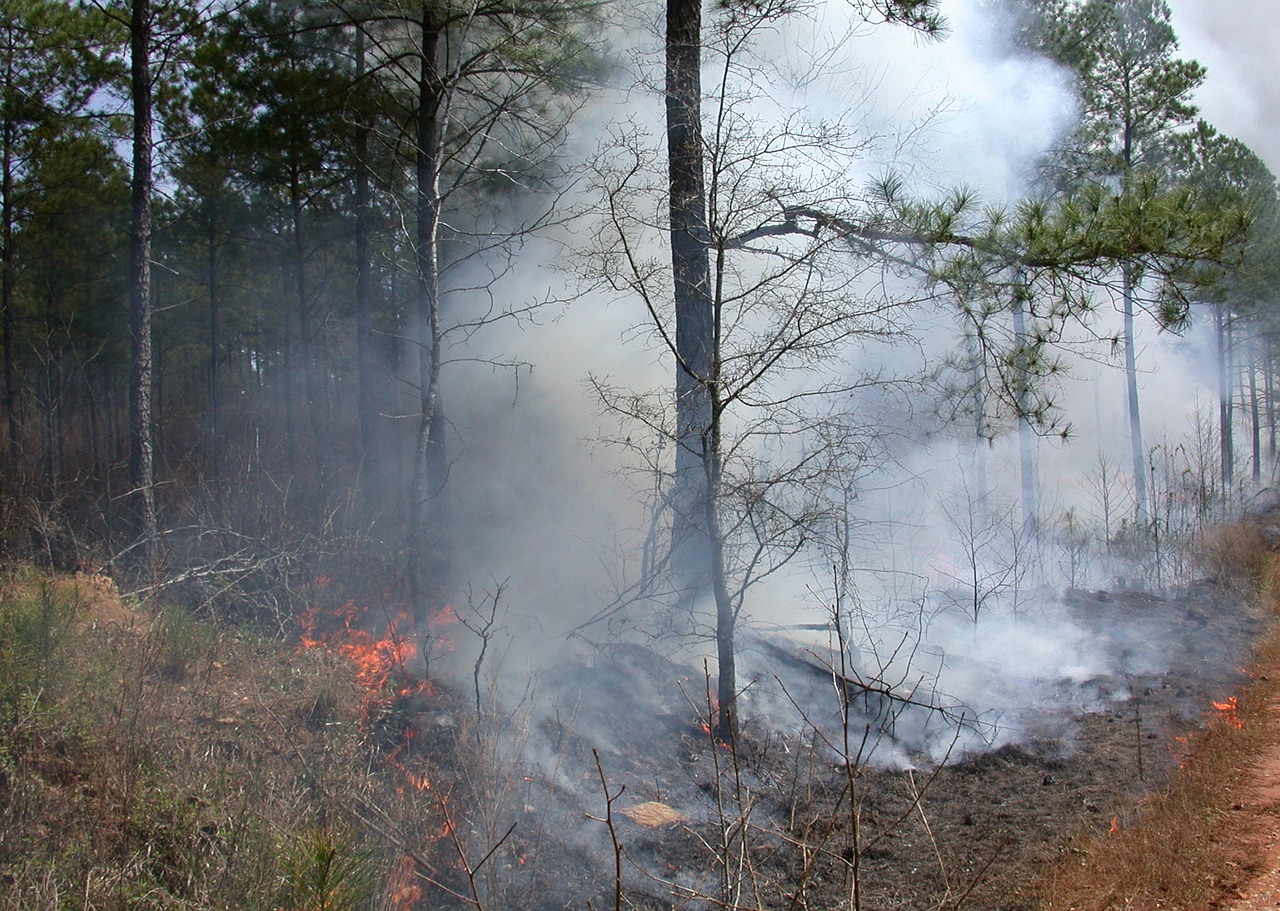
Kick through the leaf litter under an oak on a February morning and it's damp and won't hold a match. Come back at 2 p.m. and the same leaves crackle under your boot, while the big limb that blew down in November, lying three feet away, feels exactly as heavy and cold as it did at breakfast. Same sun, same air. Completely different fuel. I wanted to understand that properly, so I did the thing I always end up doing: I wrote a tiny simulator of dead fuel moisture, ran it through a day of weather, and looked at what came out. This post is that build, and it turns out to explain most of what fire weather forecasts mean when they talk about "1-hour" and "10-hour" fuels.
Fuel moisture is just a ratio (and it can go over 100%)
Fuel moisture is the weight of water in a piece of fuel divided by the weight of that same fuel after it's been completely oven-dried, as a percent. That's the definition fire agencies use (see the IFTDSS fire glossary). A stick that weighs 110 grams wet and 100 grams baked was at 10%.
Note the denominator is the dry wood. That's why live leaves can sit at 150% or more (there's more water in them than there is leaf). For dead fuels, everything interesting happens between about 3% and 30%.
The second piece is equilibrium moisture content, or EMC. Leave dead fuel in air at a fixed temperature and humidity long enough and it settles at a particular moisture and stops changing. Humid air pushes EMC up, dry air pulls it down. Every dead stick on your property is, at every moment, drifting toward the EMC of the air around it. The only question is how fast, and that turns out to be the whole game.
Timelag: the coffee-cup model
Water has to reach the surface of a fuel to leave it. A dead grass blade is almost all surface. A 6-inch log is almost all interior, and the water in the middle has a long walk. So the standard model treats fuel moisture like a cup of coffee cooling toward room temperature: it closes the gap to its target exponentially, fast at first and then slower and slower.
The timelag is how long it takes to close about 63% of that gap (63% is 1 − 1/e, which is just what the exponential spits out). Fuels are sorted into four bins by diameter, per this Northwest Fire Science Consortium fact sheet:
1-hour fuels: under ¼ inch. Dead grass, leaves, needles, small twigs.
10-hour fuels: ¼ to 1 inch. Pencil-to-thumb-sized branches.
100-hour fuels: 1 to 3 inches. Wrist-sized limbs.
1000-hour fuels: over 3 inches. Logs and big down limbs.
Because the curve is exponential, after one timelag you're 63% of the way there, after two about 86%, after three about 95%. A 1-hour fuel is caught up with the air in about 3 hours. A 1000-hour fuel needs about 3,000 hours to do the same, which is roughly four months. That's a 1,000X spread in reaction speed between things lying a few feet apart on the same ground.
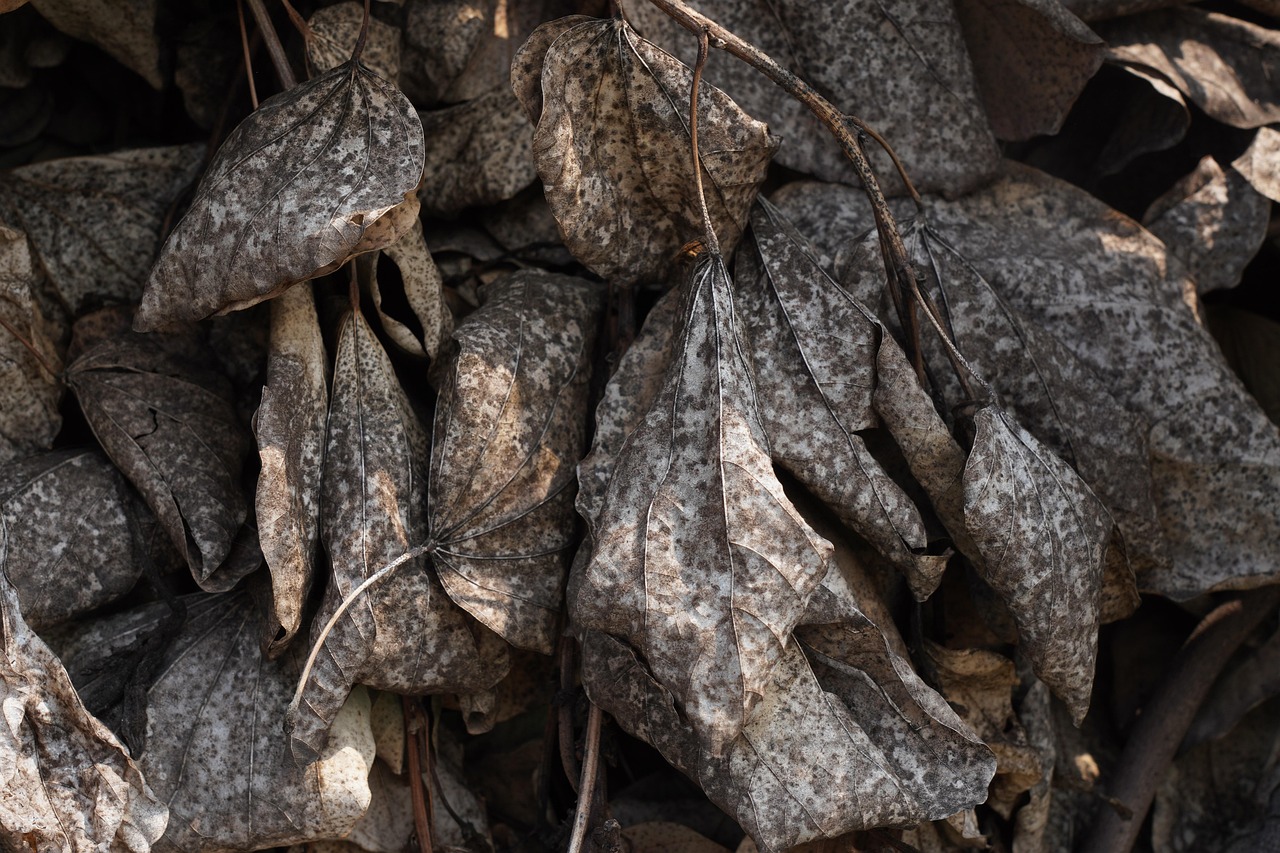
Leaf litter is classic 1-hour fuel: thin, nearly all surface, and fully caught up with the afternoon air within a few hours. Photo: Pixabay.
Building the humidity-to-moisture converter
To simulate anything, we need a function: temperature and humidity in, EMC out. There's an old empirical fit for exactly this from Simard (1968), still cited in U.S. fire danger rating work. It's three line-ish pieces stitched together by humidity band (reproduced in USDA Forest Service research paper PNW-336). In Python, with °F and percent humidity:
def emc(rh, temp_f):
    """Equilibrium moisture content of dead fuel, in percent (Simard 1968)."""
    if rh < 10:
        return 0.03229 + 0.281073 * rh - 0.000578 * rh * temp_f
    elif rh <= 50:
        return 2.22749 + 0.160107 * rh - 0.014784 * temp_f
    else:
        return 21.0606 + 0.005565 * rh**2 - 0.00035 * rh * temp_f - 0.483199 * rh
Running it over a grid gives this:
Relative humidity | EMC at 60°F | EMC at 80°F |
|---|---|---|
15% | 3.7% | 3.4% |
20% | 4.5% | 4.2% |
25% | 5.3% | 5.0% |
30% | 6.1% | 5.8% |
40% | 7.7% | 7.4% |
50% | 9.3% | 9.1% |
60% | 10.8% | 10.4% |
70% | 13.0% | 12.5% |
80% | 16.3% | 15.8% |
Two things jumped out at me. First, temperature barely matters directly: 20 degrees of warming moves the answer by about 0.3 percentage points. Humidity does nearly all the work. (Temperature still matters a lot indirectly, because warm afternoons are when humidity crashes.)
Second, there's a rule of thumb hiding in the table: in the 20–60% humidity range, fine dead fuel moisture is roughly relative humidity divided by five. 20% RH → about 4%. 40% → about 8%. It drifts above 60%, where the curve bends up, but for a gut check while standing in a field staring at a weather app, it's surprisingly close. To be clear, that's my shorthand read off the equation, not an official rule, so use it as a sanity check rather than a prescription number.
Running a day through the simulator
Now the fun part. I wrote a loop that steps hour by hour, nudging each fuel class toward the current EMC by the exponential rule, and fed it a fairly ordinary late-winter day: humidity peaking at 85% around 5 a.m. and bottoming at 25% around 3 p.m., with temperatures swinging between 45°F and 75°F. I ran the same day on repeat for 120 days so the slow fuels could settle, then read off the last one:
Time | RH | 1-hour | 10-hour | 100-hour | 1000-hour |
|---|---|---|---|---|---|
6 a.m. | 84% | 18.3% | 13.1% | 11.1% | 11.0% |
9 a.m. | 64% | 13.0% | 13.3% | 11.2% | 11.1% |
11 a.m. | 46% | 9.6% | 12.6% | 11.2% | 11.1% |
1 p.m. | 31% | 6.8% | 11.5% | 11.1% | 11.0% |
3 p.m. | 25% | 5.4% | 10.4% | 11.0% | 11.0% |
6 p.m. | 32% | 6.0% | 9.2% | 10.8% | 11.0% |
The 1-hour fuels swing from 18.3% at dawn to 5.4% at 3 p.m., a more than 3X change in a single day. The 10-hour fuels move about 4 points. The 100-hour fuels move half a point. The 1000-hour fuels don't move at all; they're just sitting at the average of the whole season. That's the oak-leaf-versus-oak-limb puzzle from the top, reproduced in a dozen lines of code.
A subtler thing I didn't expect: at 9 a.m. the 10-hour fuels are actually wetter than the 1-hour fuels, and they keep drying into the evening after the leaves have already started picking water back up. They're running a few hours behind the weather. I suspect this is part of why burns can feel deceptive mid-morning: the fine stuff is already ready, the twigs aren't quite, and by mid-afternoon everything has lined up on the dry side at once.
What the numbers mean for a burn
A moisture number is only useful if you know what it does to fire. Oklahoma State's OK-FIRE guide to prescribed burning gives bands for 1-hour and 10-hour fuels that I find very clear:
Above 20%: fire may not spread, and you can get heavy smoke.
7–20%: the normal range for prescribed burning.
5–7%: containment becomes difficult; spot fires get more likely.
Below 5%: unsuitable for prescribed fire.
Texas A&M AgriLife's general prescription lists 5–12% fine dead fuel moisture for its summer burn windows, so the two sources broadly agree on where the action is. Now feed those bands back through the converter: 7% lines up with roughly 35% RH, and 5% with roughly 25% RH. So when a burn plan gets nervous as humidity heads into the 20s, that isn't an arbitrary number. It's about where your 1-hour fuels cross into "an ember that lands outside the line will probably catch." That's also the point where your firebreaks stop being a formality, and if the forecast carries a Red Flag Warning on top of it, the answer is simply no.
In my simulated day, that means a comfortable window from late morning to about 1 p.m., with the fine fuels sliding into the 5–7% zone by mid-afternoon. And the early morning fails from the other side: 18% fine fuel moisture is the smoky, smoldering, won't-carry burn a lot of people experience the first time they light up at 7 a.m. ¯\_(ツ)_/¯
The fuels that remember last month
The flame front mostly runs through the 1-hour fuels. But the heavy fuels decide two other things you care about: how long stuff keeps burning after the front passes, and how much heat goes into the soil and the base of trees.
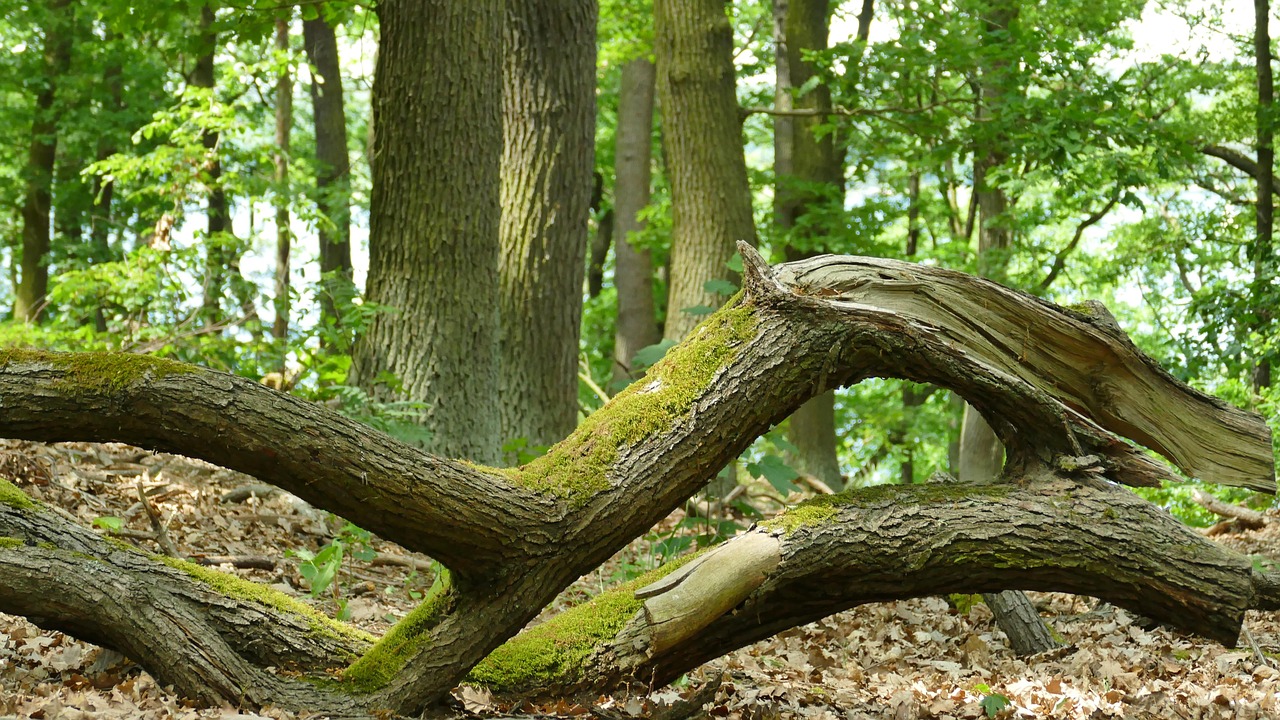
Down limbs over 3 inches across are 1000-hour fuels. They take months to dry, and once dry they can smolder long after the flame front has passed. Photo: Pixabay.
Look at that flat 1000-hour column again. Those fuels aren't reacting to today at all. They're a running average of recent weeks. After a long dry spell they're dry all the way through even if this morning was humid, so the surface fire might behave politely while every log becomes an ember source you'll be mopping up for days. After a wet month it's the reverse: the leaves on top burn while the logs underneath barely char.
The NWCG fire behavior field reference suggests a shortcut: once you know your 1-hour moisture, add 1–2% for 10-hour and 2–4% for 100-hour (see the NWCG dead fuel moisture page). That's a decent estimate on a normal day. My simulator shows exactly where it breaks: at 3 p.m. the 10-hour fuels were 5 points above the 1-hour, not 1–2, because they were still carrying the morning's moisture. It breaks worse after big weather changes, which is precisely when the slow fuels are out of step with the fast ones. If it's been dry for weeks, check the drought picture on the U.S. Drought Monitor (here's how drought levels affect your burn window), since that's what your heavy fuels are actually reflecting.
If you've ever seen a fire weather station with wooden dowels hanging in a rack, that's this idea made physical. Those are 10-hour fuel sticks: standardized pine dowels with a known oven-dry weight, left out in the weather and weighed, so the weight gain reads out directly as 10-hour fuel moisture. No model, no estimate, just a stick on a scale. I love this. If you want to see the modeled version for your area, the Forest Service's Wildland Fire Assessment System publishes fuel moisture estimates from 1-hour through 1000-hour fuels, and Oklahoma's Mesonet runs a 1-hour dead fuel moisture map that updates every 15 minutes.
The overnight reset
Put the pieces together and you get a daily breathing rhythm. At night, temperature falls, humidity climbs, EMC rises, and the 1-hour fuels follow it up within a few hours. By dawn they're often in the teens. Then the sun comes up and they dry right along with the air, bottoming out mid-to-late afternoon.

Overnight humidity recovery resets fine fuels every night. Dew is the visible sign the air near the ground got damp enough for dead fuels to soak water back up. Photo: Pixabay.
This is also why a night with poor humidity recovery should make you cautious about the next day. I tried it in the simulator: cap the overnight humidity at 55% instead of 85% and the dawn fine fuel moisture drops from about 18% to about 10%, so you start the day already halfway to the danger zone. The forecast number to watch for that isn't the afternoon minimum, it's the overnight maximum.
The big caveat on all of this: the equation assumes fuel sitting in shade at air temperature. Real fine fuels lying on a sunny south-facing slope get cooked by the sun and run drier than the formula says, most likely by a few percent. The NWCG reference tables add corrections for shading, slope, aspect and time of day for exactly this reason. So treat the converter as a way to understand the shape of the day, not a precise reading of what's under your boots. When the two disagree, believe the field.
Folding it into a burn plan
Read the hourly humidity, not just the daily low. Your National Weather Service fire weather forecast has it, and so does the hourly burn score in BurnAtlas. Divide by five and note where it crosses 7% (about 35% RH) and 5% (about 25% RH). That's your comfortable window and your hard stop.
Check the overnight recovery. A humid night buys a forgiving morning. A dry night starts the clock early.
Ask what your heavy fuels remember. Weeks of dry weather mean logs and stumps will burn and smolder. Plan longer mop-up, or pull heavy fuels back from your lines before lighting.
Snap a stick. A pencil-sized twig that bends is wet; one that snaps clean is dry. Your hands are an underrated weather station.
Write the numbers into the plan. Put the humidity limits in your prescription (our free burn plan generator can help you write the plan up) so the go/no-go call gets made in advance, while you're calm, instead of in the field, while you're excited.
None of this replaces local burn bans, permits or experienced help. What I like about it is that a pile of burn-day folklore ("burn in the morning," "watch out after a dry week," "logs hold fire") falls out of one exponential and a three-line equation. The obvious next step is wiring real hourly forecasts into the same loop instead of my made-up sine-wave day, at which point it stops being a toy and starts being a pretty useful planning tool. That's an experiment for another post.
Frequently asked questions
What does "1-hour fuel" actually mean?
Dead fuel thinner than ¼ inch: grass, leaves, needles. The "1 hour" is its timelag. It closes about 63% of the gap to a new humidity level in roughly an hour, and is essentially caught up within three.
What fuel moisture is good for a prescribed burn?
OK-FIRE treats 7–20% fine dead fuel moisture as the normal prescribed burning range, with 5–7% making containment difficult and anything below 5% unsuitable. Always follow your own written prescription and local guidance.
Is there a quick way to estimate fine fuel moisture from humidity?
In the 20–60% humidity range, relative humidity divided by five lands close to the equilibrium value. Expect sun-exposed fuels to run a little drier than that.
Why do logs keep burning after the grass fire has passed?
Logs are 1000-hour fuels. Their moisture reflects weeks or months of weather, so after a dry spell they're dry inside and can smolder for a long time even when the surface fire was mild.